
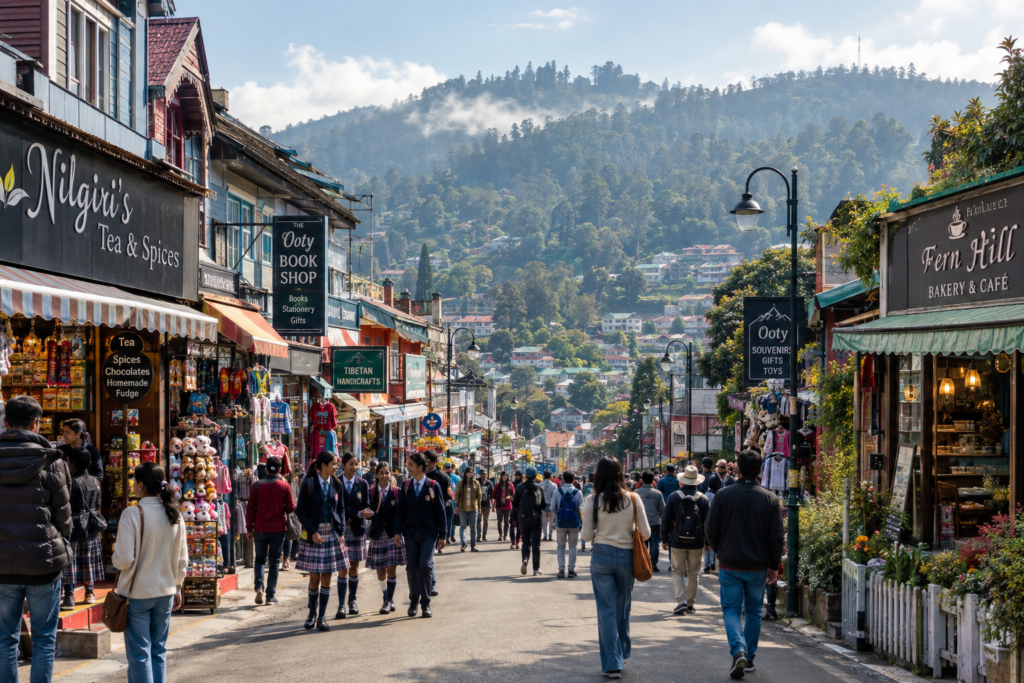
My brother’s mid-term break was always in October, a yearly tradition that pulled us straight into the misty hills of Ooty. It was undeniably beautiful, wrapped in soft clouds and crisp mountain mist, even if a quiet kind of heartbreak lingered in the chilly air. But there was also the magic of stunning backdrops, the crisp mountain breeze, slices of thick, gooey chocolate cake, cups of Nilgiri tea, wholesome get-togethers and the untouched serenity of the lake. The ache of the journey was real, but so was atmospheric allure.
Ooty has remained, for me, a place of cold, grey days, eucalyptus-scented air and the comforting smell of bread baked in wood-fired ovens. But beneath all that beauty lingered another memory: the peculiar loneliness of a child who had been taken somewhere beautiful and still wished, desperately, to be elsewhere.
Even now, nearly thirty years later, I can remember the ache of leaving Kolkata for Ooty, just when the city would start to come alive for Durga Puja. The lights would be going up, the pandals taking shape, the exhilarating sounds of dhaak reverberating in the air, and every lane preparing for a week of wild celebration.
And I would be leaving all of it behind. While my friends were getting their new clothes stitched and making plans for pandal-hopping, I would be packing my winterwear and heading south, towards the misty hills of Ooty. It felt like an especially cruel exchange: the warm, noisy embrace of my city for the cold air, grey skies and long afternoons of a wintry hill station. 
My brother was studying in Good Shepherd Public School in the 1990s (I am a little fuzzy on the exact years), and his mid-term breaks usually fell in October. And leaving Kolkata during Puja was, to my young mind, a fate worse than anything I could imagine.
Leaving Kolkata Just When the City Came Alive
Now for anyone who hasn’t yet encountered the glorious madness of Pujo in Bengal, it is something that needs to be experienced to be truly understood. It is an intoxicating vibe, a joyous fever, and a delicious delirium that takes over everything.
Overnight, familiar streets explode into light, music and colour. Every lane is crammed with food stalls, and every corner is packed with people dressed in their best. People wander from one pandal to another, thronging the streets all night, in a glorious, unrestrained celebration of the Divine Mother.
For years, puja holidays for me meant a week-long trip to the mist-shrouded hill station of Ooty, where the biting cold and thin air often made me dizzy and weepy. As an anemic child of about 10 to 12, the cold air lashed at my face, crept into my sweater and stung my eyes.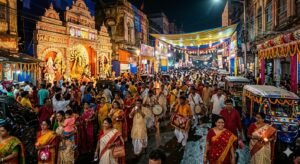
The entire town, even though picturesque, quaint and cloud-wrapped, would uncomfortably bring to mind the horror stories of Ruskin Bond (set in hill stations like Shimla and Mussoorie), especially when the sun set.
The Gruelling Train Journey
The journey itself was exhausting. It involved a two-day train ride from Kolkata to Madras, followed by a three-hour winding drive up from Mettupalayam to Ooty. The trip was so grueling that it felt like the only thing my parents were entirely focused on was seeing their precious son, leaving me to just endure the grueling travel in the background.
I would eat almost nothing on the train, taking sips of water (not too much though as that would mean making trips to the matchbox-sized filthy washroom) with grapes and dry cake rusk. For my parents, it was an adventure but for me an excruciating exercise in nausea and motion sickness. 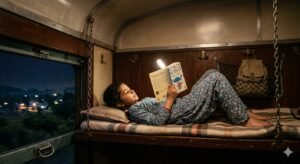
As the train rolled south, the landscape slowly changed outside the window. The familiar flatness of Bengal gave way to green fields, small stations, red earth and unfamiliar towns. Hours melted into one another. Inside the compartment, life settled into its own rhythm. The chug chug of wheels, tea sellers passing through, the rustle of newspapers, and my parents striking up an instant friendship with fellow travelers.
Food was of course a big part of the experience. At meal times, the clutter of steel trays and cutlery was my cue to creep back into my blanket. The smell of the railway meals were enough to make my stomach turn. Even though the food looked appetizing- the neatly segregated chicken, some kind of vegetable curry, a mound of pearly white thin grained rice, rotis wrapped in foil, and pickles and curd. 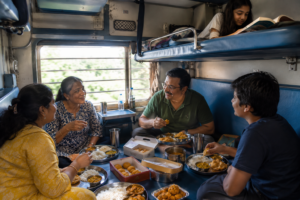 My father’s eyes would always light up at the sight of the food approaching. However, it was not exactly pleasant for me. I would keep my head buried in the book, steadfastly ignoring the persistent sounds of chewing, slurping, the rustle of food wrappers and the occasional belch floating up from below.
The home cooked food packed in steel tiffins would be devoured on the first night itself, my parents sharing their luchi, keema, cutlets and aloor dum with alacrity with their new-found friends. My books were my friends during those never-ending journeys and I would alternate between PG Wodehouse, Roald Dahl, Sunil Gangopadhyay and of course my favourite Ruskin Bond. The world of books was my haven and when I wasn’t reading, I was lying in a comatose state on an upper berth, lulled into a trance by the constant motion of the train.
A Stopover in Madras
Even the brief stop in Madras (sometimes mercifully an overnight halt) would mean more lavish and piping hot meals- predictably ghee-fried dosas, fluffy idlis, tall glasses of cold coffee and pillowy bhaturas with greasy chholey. For as soon I disembarked from the train, my appetite would bounce back with renewed vigor. And after almost two days of surviving on water and fruits, I would be ready to devour anything that tasted half-way decent.
Ooty: Beautiful, Bleak and Slightly Haunted
The drive from Mettupalayam to Ooty was another masterclass in keeping my stomach from staging a revolt. The road twisted relentlessly upwards, curling around the mountains in one dizzying bend after another. I would press my forehead against the window, watching the hills swing past me, my stomach churning with every hairpin turn. 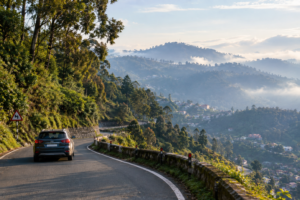
Now that I look back, loneliness was a constant companion. Even when surrounded by people from all sides, there was always a hollowness deep in me that I couldn’t quite express. It wasn’t just the Ooty trip. It was every moment of everyday life. And the entire journey got even more harrowing because I was leaving my city behind, the pujas and my aged grandparents. Every October was a life sentence on repeat.
On our way to Ooty, superhit songs from movies like Hindustani (Kamal Hassan and Urmila Matondkar starrer), Rangeela and Humse Hai Muqabla played from the scratchy speakers of rented vans, the songs acquiring a distinct thin metallic whine. I would inch closer to my mother, shivering as the temperature started to plummet. In the front seat, my father would be deep in conversation with the driver. I was always surprised at how well they all spoke English since cabbies in Kolkata only spoke in Bengali or Hindi.
Hotel Nahar and the Room with the Dismal View
The hotel of our choice was usually Hotel Nahar at Charing Cross. I have been there so many times as a child that when I close my eyes, I can still see the familiar sloping road with shops and hotels on every side. Charing Cross was always busy. There was constant traffic, people hurried along in sweaters and mufflers, and shopkeepers stood in their doorways watching the mist roll in.
There were little shops, buses and well-dressed affluent people everywhere you looked. All the hostels usually had their midterm breaks around that time and so the sleepy hill station would come alive, with every hotel booked to capacity and every eatery and bakery thronging with students and their guardians. There was always the smell of eucalyptus, freshly baked cakes and a vague smell of horse dung on the streets.

Hotel Nahar was a different story altogether. For a child who had spent the better part of two days feeling sick on a train and then another few hours being thrown around a mountain road, it felt wonderfully plush. The rooms were warm and neat, with comfortable beds, carpeted floors and the sort of heavy, cosy furniture that made you want to curl up and stay indoors.
The only downside was the view from the window. Maybe there were rooms with better views in the hotel. But somehow, we always stayed in rooms which overlooked walls the colour of old ash, their paint peeling in places.
One particular year, we stayed in a room which was right next to a construction site, the pristine air punctuated with raucous shouts of laborers, the droning and whirring of equipment, and the relentless thud of hammers. But once you drew the heavy curtains shut, the room felt calm and still again.
The Invisible Girl
The first day in Ooty would always start with a visit to my brother’s grand school. With a series of events and a function, and then him accompanying us back to the hotel for the next couple of days. There would be students dressed up for performances, teachers bustling about, parents and visitors being shown around, and an auditorium full of frenzied activity that surrounds school events. 
The school was beautiful in that slightly intimidating way old boarding schools can be. The campus had buildings that were all pale walls, sloping roofs, long corridors and wide verandas, with polished floors that seemed to hold the cold of the hills.
My heart always beat a little faster when I walked into the regal looking campus. In my mind, it felt like an old English boarding school, like Tom Brown’s School days. I don’t think I ever really envied my brother for the exposure that he was getting, but there was always that underlying feeling that he was more of a priority than me. What wouldn’t I have given to enjoy the perks of studying in a school like this one?
On the way back to the hotel, Ma and Baba would have eyes only for Dada. They would fuss over him, hug him, fire questions at him and generally behave as though the prodigal son had returned from war. He was the fairytale prince who had finally graced us with his glorious presence. I was somewhat like a pet that was trailing after them. If I went missing I would be missed, but in general I wasn’t worthy of much attention.
After the obligatory warm hug, I would retreat into my own little world again, happily watching the landscape slip past on the drive back to the hotel. I didn’t have much to say to anyone. I was simply there, quiet and slightly removed, letting the hills keep me company.
The Reunion always felt like an anti-climax
When in Kolkata I would miss my brother immensely and even retreat to the bathroom for a quick silent cry occasionally. But when we met in person, something always shifted. He was loud and flamboyant, with a swashbuckling charm that was very different from what I nurtured in my imagination. And I always felt a little jaded, a little less visible in his presence.
Three to four whirlwind days of hectic activity would follow- lots of sightseeing, eating out, parties in our hotel room that continued late into the night, and nonstop shopping for chocolates, local snacks, and spices.
Goodies galore to nourish the body and soul
The food was the most memorable part of every trip. Both dada and I were always pudgy and could stand to lose a few pounds. Not that it ever bothered us. Instead, from the moment we returned from his school, my parents couldn’t stop feeding him, as if compensating for the guilt of having to send him away from home.
I remember the table beside our bed, heaped with his favorite goodies. All kinds of homemade chocolates in sealed plastic packets, big bars of Toblerone, cans of luncheon meat, soft golden brown buns which yielded with a soft, comforting sigh the moment your fingers pressed into them. 
The canned luncheon meat was a bright pink block of meat marbled with white jellied fat . The tins required a great deal of patience to coax open but once done, promised a sharp, savory hit that lingered on the tongue. It was honest, filling food, best eaten between two thick slabs of bread with a heavy dollop of butter. The intense saltiness of the meat was mellowed by the mild sweetness of the bread and made for a fabulous all-day snack.
From the moment we walked into the room and threw down our coats and sweaters, it marked the official permission for everyone to throw caution to the wind and eat until we could eat no more. Dada’s friends would keep flitting in and out of our room all day. I would change into some decent clothing first thing in the morning, knowing that a bunch of young men would be lounging around.
They saw a little sister. I saw a very cute boy
And then there was this one particular guy. Every time he walked in wearing some ridiculously loud, bright sweater and a goofy smile, my stomach did a little flip. I’d try to act casual, throwing him these painfully shy glances while we absolutely demolished room-service towers of club sandwiches, dosas, and puri sabji. By day three, we were all basically a hive mind. My brother’s friends treated me like a younger sister or a pet hamster, entirely oblivious to the fact that there was a completely smitten, hormone-addled teenager sitting right next to them.
My Father Spent Money Like It Wasn’t Real
Today, I can’t imagine how much money my father must have blown up on those trips. We were living large and mostly dining in the more expensive hotels like The Monarch (Mithun Chakraborty’s hotel), Hotel Sterling and Savoy Ooty. Today, as a tax-paying adult who understands the actual value of a rupee, thinking about the sheer volume of room service tabs and restaurant bills he mindlessly paid gives me a minor heart attack. But back then? We just ordered another round of food like they were on the house.
But there were some modest, unpretentious places we frequented as well. My father and I shared a quiet love for the smaller, unassuming eateries that could be found around every corner. I particularly remember a tiny, smoky joint right beside our hotel called Hotel Blue Hills. On cold Ooty evenings, the piping hot chicken noodle soup warmed us to the bones, and the chili pork had just the right amount of kick.
Then there was a small roadside shack where we had the most wonderful steamed idlis. They were soft and fresh, served with endless helpings of a thick, vegetable-rich sambar. My brother sat there scowling, his face a picture of pure distaste. The little prince was apparently way too embarrassed to be seen eating at a street stall, but we completely ignored him. As for me, I was just as happy sitting on that sketchy wooden bench by the side of the road as I would’ve been lounging in the fancy chairs of a five-star hotel.
The Evening Grief Sat Down With Us
My mom’s tears always started a full day before my brother had to go back to school. I’d wake up in the morning to find her face splotchy and raw, her eyes swollen shut from crying. She would have her morning cup of tea, turned away from us, sitting by herself and staring at a wall dead-eyed. And just like that, all the good cheer of the last few days would turn its back on us and disappear .
A heavy gloom would settle over all the parents in the hotel. Suddenly, everyone would realize that the holiday was over, the kids were staying behind, and it was time to go home. It was sad knowing how quickly the good times could end. Even my brother lost his usual cockiness, looking somewhat subdued.
On this particular trip, the night before we were to leave felt colder than usual. The damp seemed to settle slowly into our very bones. The town had grown strangely quiet. The familiar sounds had disappeared, leaving behind a silence that seemed to stretch from one end of the road to the other. Everything felt distant that night. Even the lights looked lonely.
To escape the weather, we ducked into Iranis, a simple, low-key diner run by a nice Jewish gentleman. It was a place we loved dropping by for their thick nutritious soups and rice dishes. The air grew heavier as we waited for the food to arrive. Outside, a thick mist had settled over the road, blurring everything beyond the pavement.
It was late evening, but it felt as if the streets had already emptied for the night. My mother sat absolutely quiet and still. My brother and I shifted in our seats uncomfortably.
To avoid the tension at our table, my dad stood by the counter chatting with the hotel owner, waiting to wrap up the meal as quickly as possible and bring a swift end to the evening.
Right next to them stood the familiar scratched, foggy glass case inside which sat the signature chocolate cake of Iranis. They were thick, insanely rich, gooey slices that made me completely swoon with every single bite. But today, I had no appetite for them.
I watched the youngish swarthy waiter approach our table with an apologetic grin on his face, his oily curls dancing with every step as he set down our plates carefully on the cheap and colourful sunmica table in front of us.
Just as he placed the last dish on the low table, I heard a low moan. My brother and I both looked up. It was my mother. Something in her had finally given way.
At first, there were only small, shuddering sobs. She tried to contain them, pressing her lips together and swiping at her face. But then the crying grew louder. Her shoulders began to shake. And her sobs turned into raw, anguished cries.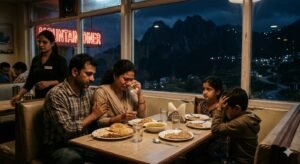
The waiter froze beside the table. He looked so alarmed that for a moment I thought he might sprint back to the kitchen. He kept glancing at her, then at the dishes, as if trying to work out what he had possibly done to make this strange middle-aged woman cry.
My father broke off mid-sentence and came rushing back to us. Around us, people had stopped eating. Forks and spoons hung suspended halfway to mouths as every pair of eyes in the restaurant turned towards us.
My hands felt cold and clammy. I had no idea what I was supposed to do, so I did the only thing I could think of: I quietly went back to my noodles.
My brother looked like he wanted the floor to open up and swallow him.
My father pulled my sobbing mother into a hug, rubbing her back vigorously, murmuring something to calm her down. Looking back, I know that as her children, we should probably have got up and held her too. But we were young, and what we felt in that moment was mostly shame and discomfort.
Why here? Why in front of all these people? She could have cried her eyes out in the privacy of our hotel room. Instead, here she was, completely falling apart in a crowded restaurant while strangers watched.
So we left as quickly as we could, abandoning the food on the table. The bright floral surface seemed almost offensively cheerful against the misery around it, a stranger to all the grief, awkwardness and pain surrounding it.
The sweet taste of chocolate and loss
To this day, a mouthful of sweet, gooey sinful chocolate cake takes me back to the soggy and bitterly cold evening in Hotel Iranis, a veritable feast laid out in front of us and no appetite for even a morsel of it.
I had always seen my mother break down whenever it was time to return to Kolkata without my brother, but this is the memory which stands out most clearly in my head.
The journey back home would be one bereft of joy and hope. The usual excitement of the train ride from Kolkata to Madras only a week ago, completely missing. As the train made its way towards the eastern part of the country, the low, rolling rumble of the wheels against the iron rails sounded like a slow, aching heartbeat. I sought refuge in a book as the train took us farther and farther away from my brother as the landscape slipped past the window.
When Eucalyptus Began to Smell Like Grief
We always returned to Kolkata with an extra suitcase that had to be purchased hastily in Ooty, its zippers strained to the limit and packed to the brim with a massive haul of goodies and keepsakes. Once we were back home, the contents, the blocks of handmade chocolate, jars of pale ghee, packets of tea, and small glass bottles of eucalyptus oil, were carefully divided into neat piles on the dining table, ready to be given away to relatives and neighbors.
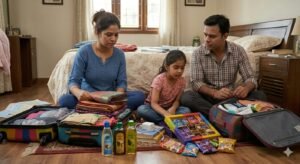
For months afterward, a sharp, woodsy, camphor-like scent would fill our apartment every evening. The cleaning lady would mix a few drops of the eucalyptus oil into her bucket, wiping down the floors to keep the mosquitoes at bay. But to me, that clean, sharp smell always held the heaviness and ache for a loved one far far away.
It was the smell of a family that was heartsick, a constant reminder that my brother was sleeping in a lonely boarding-school bed hundreds of miles away.
Even the taste of the chocolates failed to comfort me. Each bite just tasted of his absence, taking me back to the moment when we would leave for the railway station directly from his school. He would stand in front of his dormitory, dressed in his crisp school uniform, a forlorn figure becoming smaller and smaller as our taxi drove away.
I was leaving behind the version of myself that got to see my brother every day. Saying goodbye at that hostel gate felt like pulling a thread that unraveled everything. And I was heading back to a city that was also in the throes of an emotional hangover, having bid adieu to its daughter Ma Durga. In both our worlds, the only buoyant hope was that of a reunion with our loved one soon.

A content writer and lifelong book nerd rewriting the rules of her 40s, because in a world that expects women to have it all figured out, the real power belongs to those of us brave enough to tell the truth.